
Antonio Mancini, Low tide
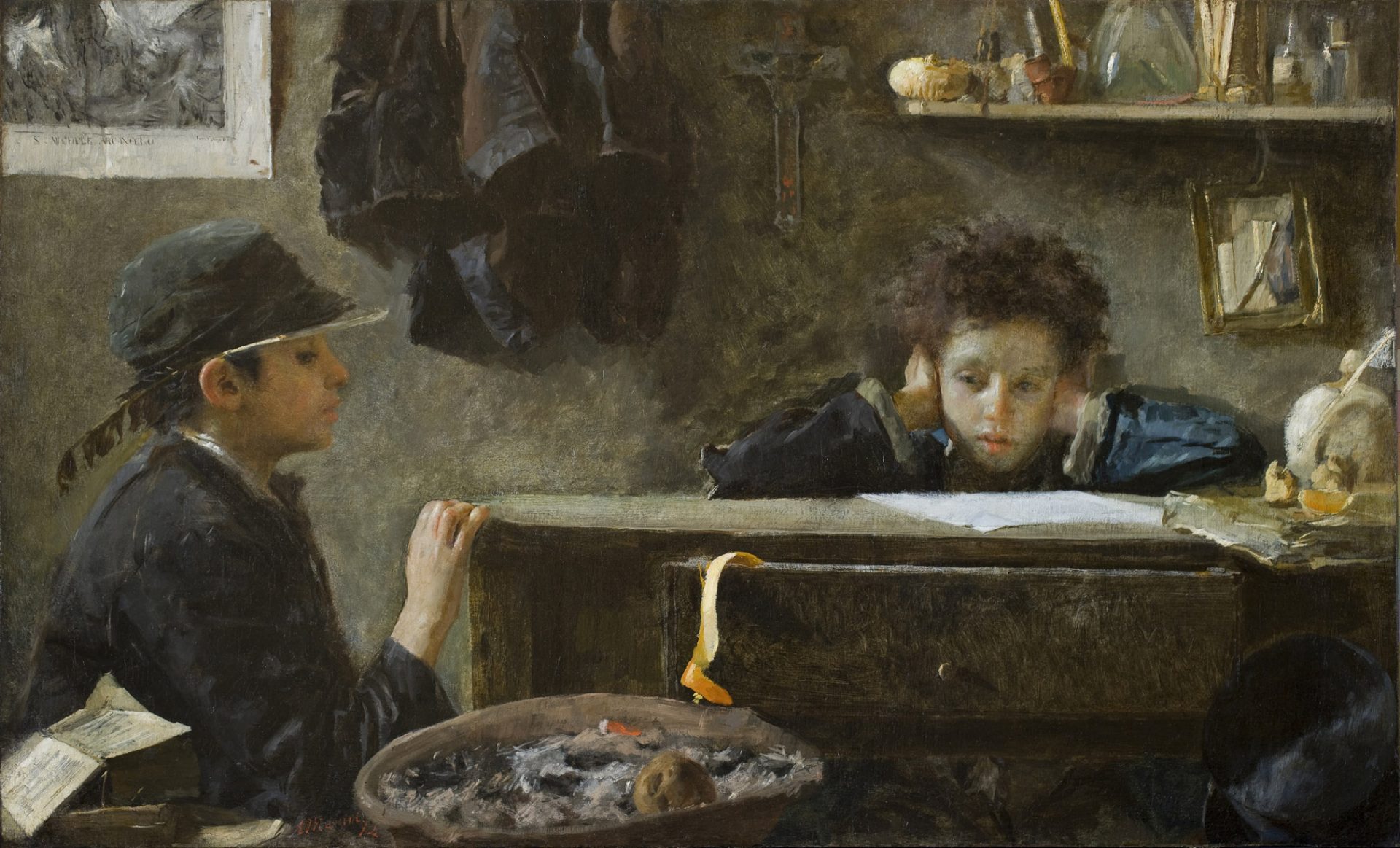
The nature of the pictorial 'Stil Novo' that Antonio Mancini invented is complex. Part of this complexity is due to the harmonic juxtaposition of Mancini’s colours and to his particular way of painting: a rare and subtle amalgam composed of a careful choice of tones and a personal method of employing them.
His refined painting possesses an analogous – if not identical – crystalline purity found elsewhere only in Caravaggio and Vermeer.
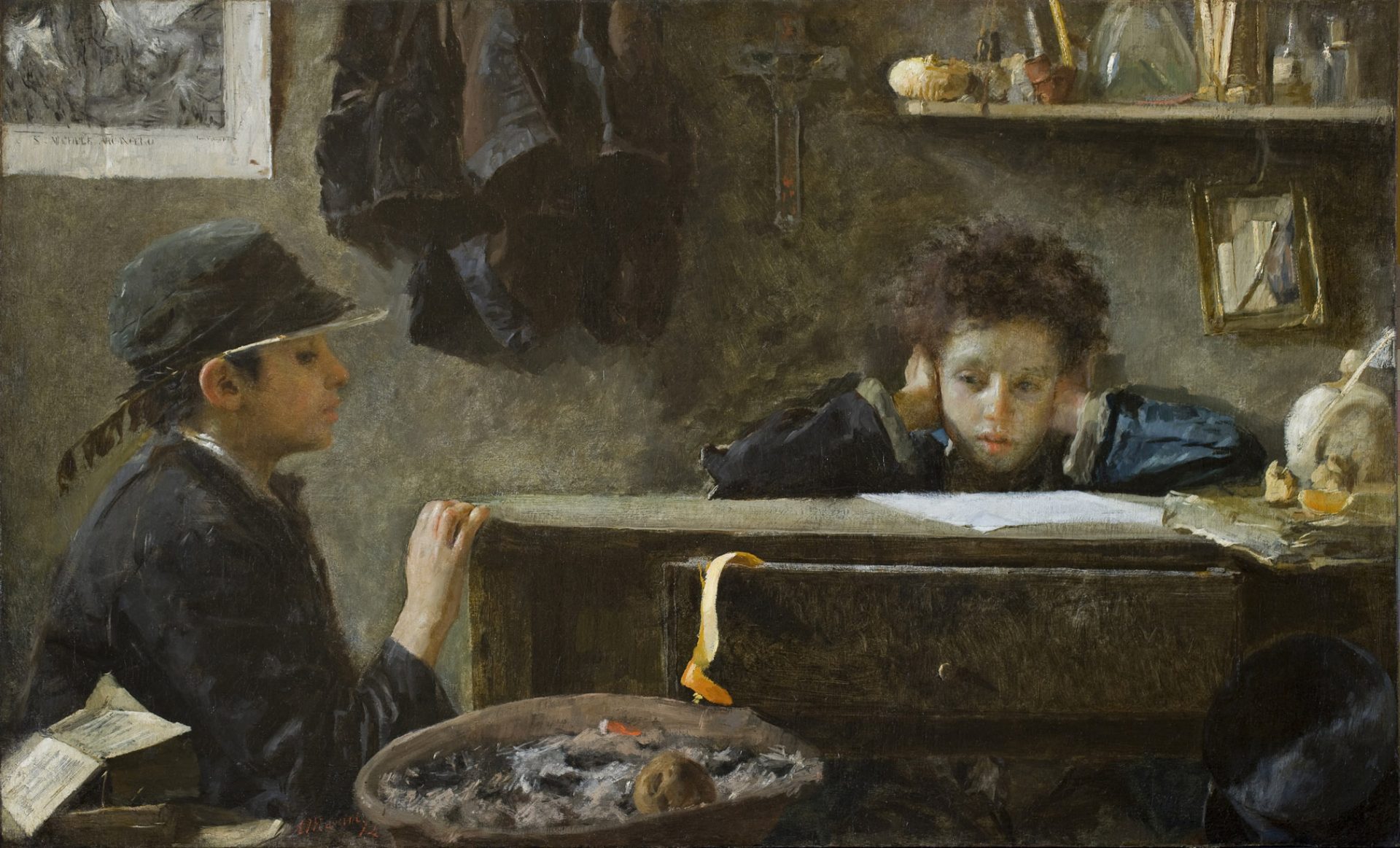
The similarities are evident when we observe paintings such as Low tide, After the studio and The broken straw, extraordinary interior scenes that are based on alternating clarity and darkness, light and shadow, where lifelike observation never abandons itself to mere anecdote or empty critical analysis. The street children of the alleyways are depicted in the half-light of meagre rooms, in the act of reading, studying, thinking. They are tired, and falling asleep on their books: their desire to learn stems from their dreams of a different reality. In Low tide the attentive and realistic depiction evokes a moving scene from years ago; the story yields to purely pictorial solutions, from the delicate flickers of light and deep shadows to the subtle measuring of the tonal relationships and refined sensibility of the spatial rendering.
The image of two famished young boys is psychologically penetrating, especially because of their faces, lost in thought. The painting presents a perfect balance between the mood of the boys portrayed and the colours of the humble interior of the room – akin to those of Vermeer at the end of the eighteenth century. The layers of paint are so skillfully applied that they simultaneously both dampen and illuminate the forms. The construction remains, however, solid, and is grounded in faithful, perennial colour. The objects depicted possess a weight and value that they must have had even in the moment the painting was executed.
Antonio Mancini
(Rome1852 – 1930)
Low tide, 1874
Oil on canvas, 80 x 130 cm
Signed and dated lower left: A. Mancini 1874
Provenance
G. Giosi, Naples; Raccolta T.M.R., Rome (1953); private collection, Rome; Raccolta Mazzetelli, Rome; private collection, Florence