
From pencil to chisel, Giuliano Vangi
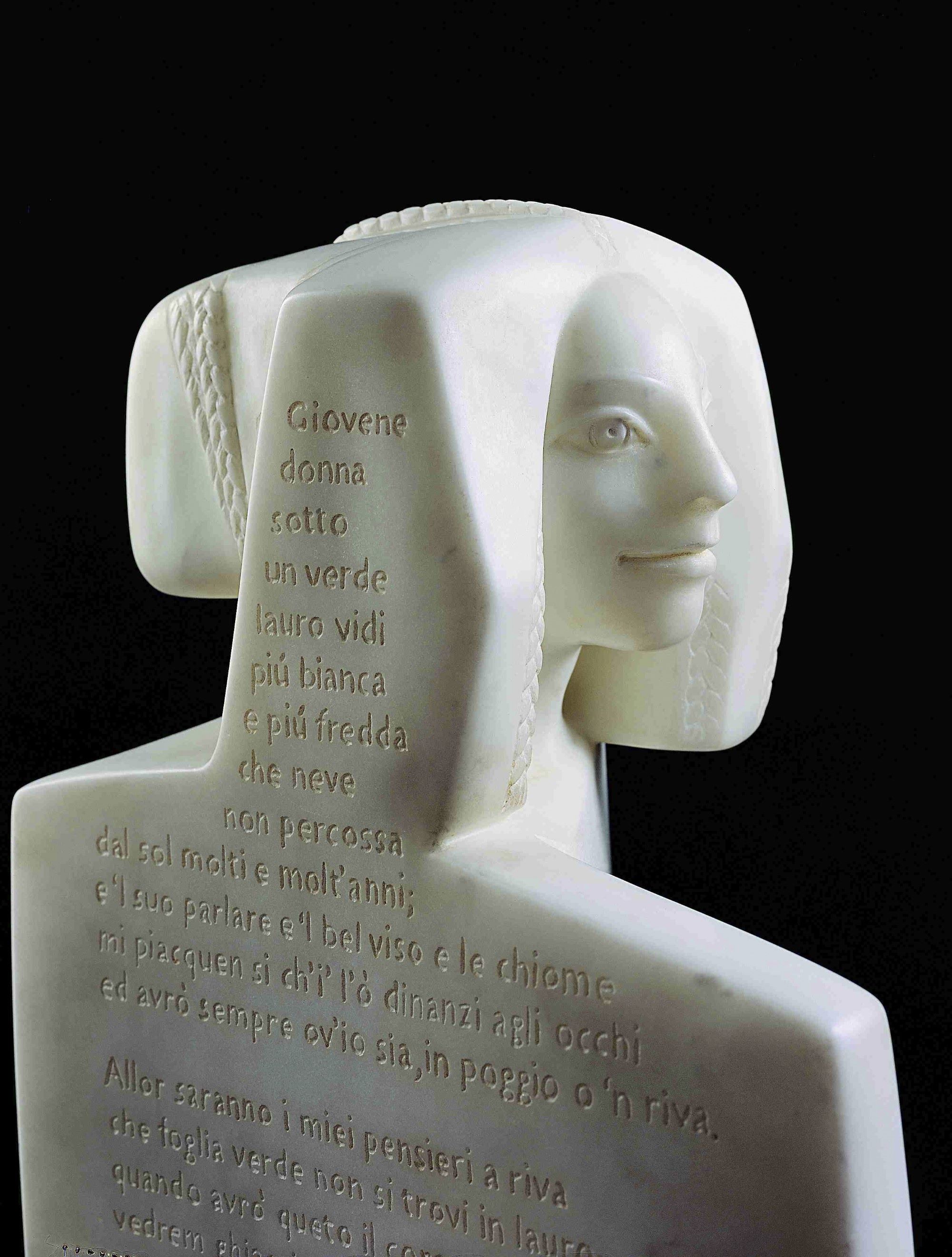
Bottegantica Gallery, Milan
In his works, Giuliano Vangi has created the modern style of the concept of Man: he has fulfilled the two necessary conditions of emptying this concept of all rhetoric and romanticism, and making it coincide - which is natural, after all - with its content.
Beyond a shadow of doubt, Vangi creates a classic form of man. His Man appears to be a typical creature of a crisis that permeates all the values of life, a creature substantiated and disheartened by the fundamental historical disease that qualifies his every gesture.

He is a professional dreamer, not able to give color and concreteness to his actions, unable to translate the complex travails of thought and ambition into spurts of will and experienced results; unprepared for the clash with the secrets of existence, in their incessant daily proposition; constantly nagged by the enormity of dreams and the paucity of actions, by a desire for love and immense throbs. He is arid and cold, unable to ignite and abandon himself to the wave of feeling; always on the verge of burning in the fire of heroism his own beleaguered personality, and exhausted in the bitter consideration of his own moral misery; The boy is desirous of a dialogue, of an encounter with his peers that would guarantee him faith in life and society, and ready to betray such sincere intentions in the selfish protection of a desperate and naive solitude; willing to build relationships of generous solidarity, of sudden and spontaneous brotherhood in the depths of his conscience, but he is locked up in the defense of himself and of his own privileged suffering from the incomprehensive glances of others.


Already in the first, uncertain articulations of his renunciatory humanity, this creature clearly denounces his substantial distance from a romantic human landscape as well as from a naturalistic landscape. Vangi submerges him in the quicksand of diuturnity, where one is involved in the limit of consciousness, on the frontier where planning alternates with unawareness, longing with abulia, impulse with automatism. In the final surrender, Vangi's man is nothing but a failed protagonist: between being and his conscience there is the unfathomable mystery, a sort of transcendence in reverse, which no longer enables the light of the empyrean, but rather pushes towards the dark cavern of the unknowable and the absurd: the cave of the human according to Platonic mythology.


However, experience is carved in characters that are both conventional and cryptographic, of which men are mere hieroglyphics, which once - millions of years ago - had their own sacredness and now wait in vain to be deciphered. Beings that act with obstinacy even though they lack convictions, that feel themselves manoeuvred by occult forces even though they are peremptory, they wear themselves out with minimal facts, they face futile enterprises and labours, on which they base their coat of arms of heroism.

Vangi's humanity, in which one can recognize an echo of Beckett, sees itself and measures itself in Hamletic characters; beleaguered, weakened by their suffering in an historical moment of profound passage, prisoners of a schematic morality that has lost its ideal and historical connective, slaves of a desperate disposition to look at oneself living, culprits and victims of a social debacle and a spiritual disintegration. A humanity, however, that from its state of mere passivity transfers on a plane of inner process the analysis of its own negativity and repulsion, until it portrays itself as a conscious expression of a decadent society anxious for a better humanity.
The particular accent of Vangi's narrative inspiration does not lie, as is obvious, in the described typicality of the characters, in their being the subject of an historical and spiritual atmosphere, nor in a miraculous, almost automatic, representation of that crisis in an objectively valid, unconsciously realistic image of that world, completely independent of the author's ideological position. Rather, it consists in the particular way of expressing, as well as documenting, that crisis, that is, in the ability to liberate his troubled vision of life in figures and relationships of fantasy; in identifying in free, suffering creatures the terms and conditions of his own 'historical' melancholy. Vangi has told us, yes, something important about the structures of contemporary life. But more than this, we are interested in his organic understanding of that era, which manifests itself in that violent attack on the depths of consciousness where the crisis is clarified in its atavistic, spiritual manifestations, in the historical condition of decadence.

It is enough to observe the 1978 work Man with Footsteps, where a modern Odysseus travels along and retraces a road, or an alley, dragging along the wreckage of a hell that he carries within himself, the torn edges of an absurd existence: already rotten and yet immature, experienced and worn and yet tied to forms of prenatal innocence; tired and spoiled but still stirred by obscure unexpressed yearnings. After all, all Vangi's characters sail a boundless sea, where instincts, cowardice, hopes, violence and renunciations boil and get tangled around themselves; and they drift aimlessly. At every moment, they forget the route and the landings, and they are emptied of themselves, like the boat is freed of ballast, and suddenly they are filled with sensations, old reactions, ancient projects, and they remain ensnared in the many intentional or failed ambitions: and in the end, they rehash the remnants of their own experience in perpetual rambling.
At the end of the day, when all is said and done, despite the artist's attempts to vitalize his poetic world with metaphors, analogies, and improbable identities, one has the highly poetic impression of an immense shipwreck where the anonymous and indecipherable debris of a daily routine floats by, flotsam that is both obsessive and futile, coercive and fatuous, providential and fortuitous. A negative and tragic everyday life, therefore, in which the admirable verses of Eugenio Montale seem to echo in his conversation with the ancient sea:
You were the first to tell me
that the petty ferment of my heart was but a moment in your own;
that lying deep within me was your law, with all its hazards:
to be vast, to be diverse, yet to be fixed;
and so to purge myself of all uncleanness
just as you do when you toss upon the beach
amongst the cork, the seaweed and the starfish
all the useless debris drawn from your abyss.