
Emilio Longoni, The voice of the stream
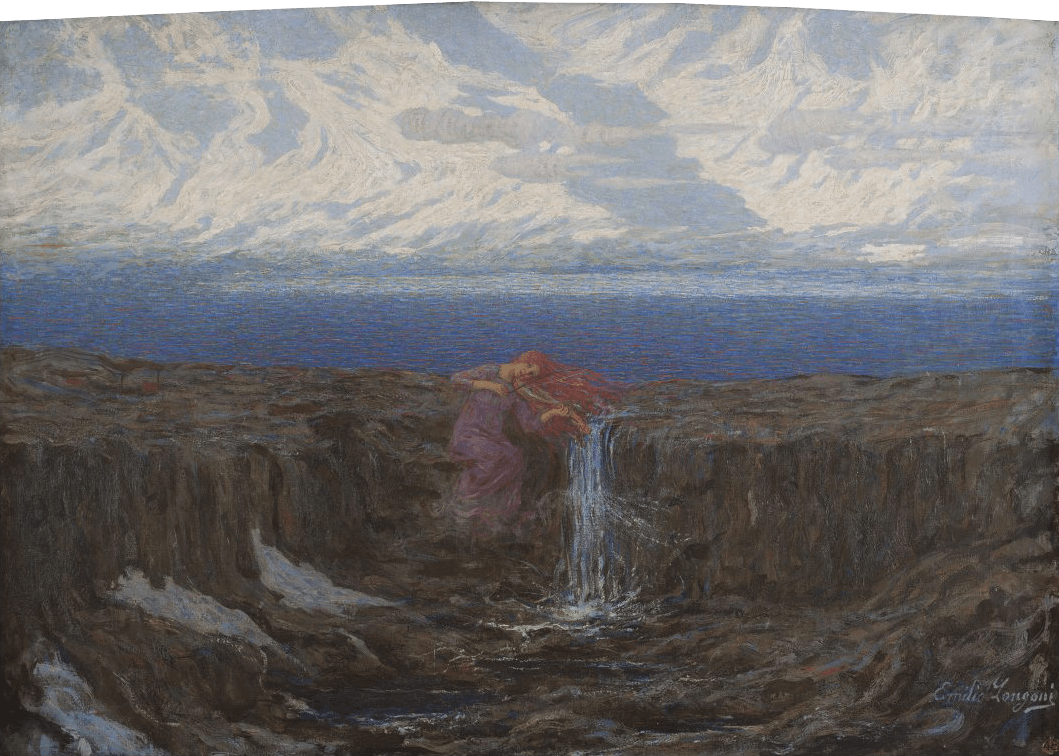
Longoni's paintings in the series of works collected under the title of La voce del ruscello (The Voice of the Stream), are absolute masterpieces of his symbolist period. Executed between 1901 and 1904 at high altitude, precisely on the Bernina massif, they stand independent of each other in their exhibition history, market and critical fortune.
The work in question is the second version of the series, which, as part of the Universal Exhibition of Saint Louis in 1904, won the silver medal. When it was awarded this prize, it was presented under the title of The Murmur of the Brook.
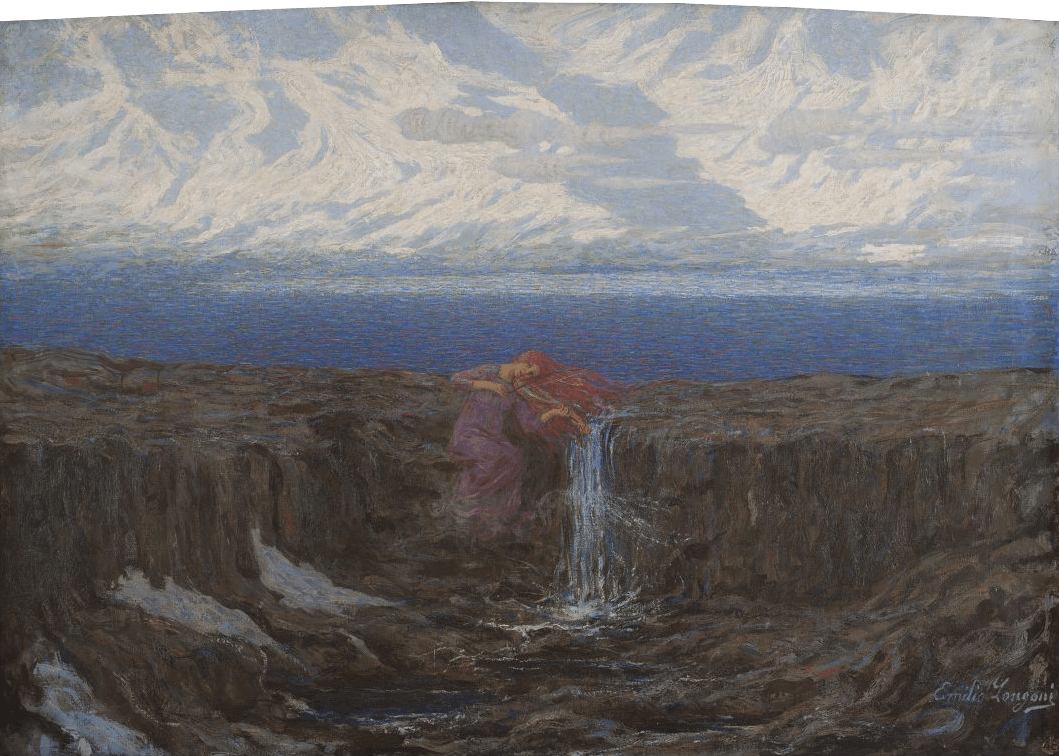
In conceiving it, Emilio Longoni wanted to pay homage to the great alpine panoramas of his friend and colleague Giovanni Segantini, who died in 1899. The location portrayed is near the Lago Bianco del Bernina, in the Swiss region called Engadina. Crystalline waters emerge from the granite mass of the rock which acts as a visual and chromatic filter between the rocky streambed in the foreground of the painting and the the body of water and the vast glacier in the background.
For each of these elements the painter adopts a different technique with the aim of recreating their particular essence: a weave of thin horizontal filaments of pure lapis lazuli for the glacial transparencies of the water mirror; crushed and superimposed brushstrokes for the centuries-old mineral stratification of the rock; a creamy and shaded layering for the effect of distance of the Alpine chain, veined with tongues of ice.
In the middle of the rock mass sits a young female figure with long red hair - ethereal, like a Pre-Raphaelite muse - next to which a stream gushes from the alpine lake; the young girl - personification of harmony - leans toward the water source to imitate the sound with the zither she holds in her hands. Through the use of this allegory, Longoni recreates in images the melody of nature and its regenerative value, the sounds of the spheres that penetrate the secret sense of things and discover hidden messages in them. The humble and naturalistic aspects of this silent high-altitude landscape - stretching wide as on a panoramic screen - are captured in their objective precision but, already transcribed behind intimate suggestions, they are charged at the same time with a symbolic and affective value: they become elements of a world where human emotion is still possible, and where it is possible to find an alternative in other skies, as well as in other dimensions of living.
Emilio Longoni
(Barlassina 1859 – Milan 1932)
The voice of the stream, 1904
Olio su tela, 100 x 140 cm
Signed lower right: Emilio Longoni
Provenance
Pietro Curletti, Milan (since 1906); heirs Curletti, Milan; Fiorenza De Gaspari Longoni, Milan(since c. 1940); private collection, Milan