
Venetian Art in the 1800s, Masters of Colour
Bottegantica Gallery, Milan
Forty works by Guglielmo Ciardi, Giacomo Favretto, Ettore Tito and Federico Zandomeneghi retrace the extraordinary artistic achievements of the Venetian school of the second half of the 19th century, a school that made colour its trademark.


The exhibition, curated by Enzo Savoia, presents a selection of forty works from prestigious private Italian collections, many of which have never before been shown to the general public. Seen together, they document the rise of the Venetian school of 'real' painting, executed en plein air, in which the representation of reality is brought back to its essential values. This sensation of freedom, of happiness in the open air, and of learning to perceive and record the slightest variations in light, led the painters to come out of the darkness of their studios and fully immerse themselves in the light and colours of the Venetian life of their time.


Guglielmo Ciardi (1842-1917) was the leader of the young painters, undoubtedly the most gifted of them all and the one most attracted to the expressive possibilities inherent in the shift towards reality that was taking place at a European level. As the 'predestined' heir of Canaletto, Guardi and Bellotto, he was able to transfer onto his canvases the elusive sensation of Venice, as we see in the work Canal Grande. Aware of this changeable dimension of reality, he preferred the open view of the sea to the view of the mainland, where the atmospheric effects are better able to restore the lights and colours of the landscape and the elements that populate it.

Giacomo Favretto (1849-1887) was also a innovator and dominator of modern Venetian painting. His genre scenes are pictures of life, imbued with the psychology, colour and atmosphere necessary for the work to be clearly defined and moving. His paintings are not regulated by a logical development, but by his instinctive technique, one which preserves, in its elusive lightness, the lively rhythm of life observed and transfigured. In Fantasticando, Favretto proves to be a realist who takes from a scene the movement and certain colors, but not the volume, the depth, or the problems that radiate within it. His themes go beyond the dramatics of life. Even when he carries out serious subjects, such as the miserable conditions of the fishermen of Burano and Chioggia, he observes not the pains, but the amusing sense of the situation.
Luigi Nono's (1850-1918) painting is indebted to the realism of Ciardi and Favretto, but his works reveal a more thoughtful, lyrical character, more directed towards meditation. The artist is interested in a conception of life that, in a very broad sense, can be said to be religious. He focuses on the insistent fragility of things, in the search for a subtle pattern of correspondences between mood and landscape, as in Sunday Morning.
Antonio Rotta, Alessandro Milesi, Egisto Lancerotto and Angelo dall'Oca Bianca, under the impulse of Realism, were pushed to capture on canvas the changing luministic and atmospheric effects of the lagoon and the mainland. Their subjects included springs, lakes and streams, but also impressions born from popular life, such as the activities of fishermen and gondoliers. In the sphere of 'pure' vedute, Ciardi's lesson was accepted and developed by his children, Beppe and Emma, as well as by Pietro Fragiacomo. In the works of the latter, space becomes an emotional environment, the view becomes contemplation, and the daily dimension of the work of the fishermen becomes a shared experience of humanity, as in Piazza San Marco.
Ettore Tito (1859-1941) was an exceptionally skilled colorist: his task was to bring Venetian painting into the new century. The artist liked to play with colors, volumes and planes, in a kind of improvisation that reflected his passion for mastering pictorial and technical difficulties that allowed him to demonstrate his virtuosity.
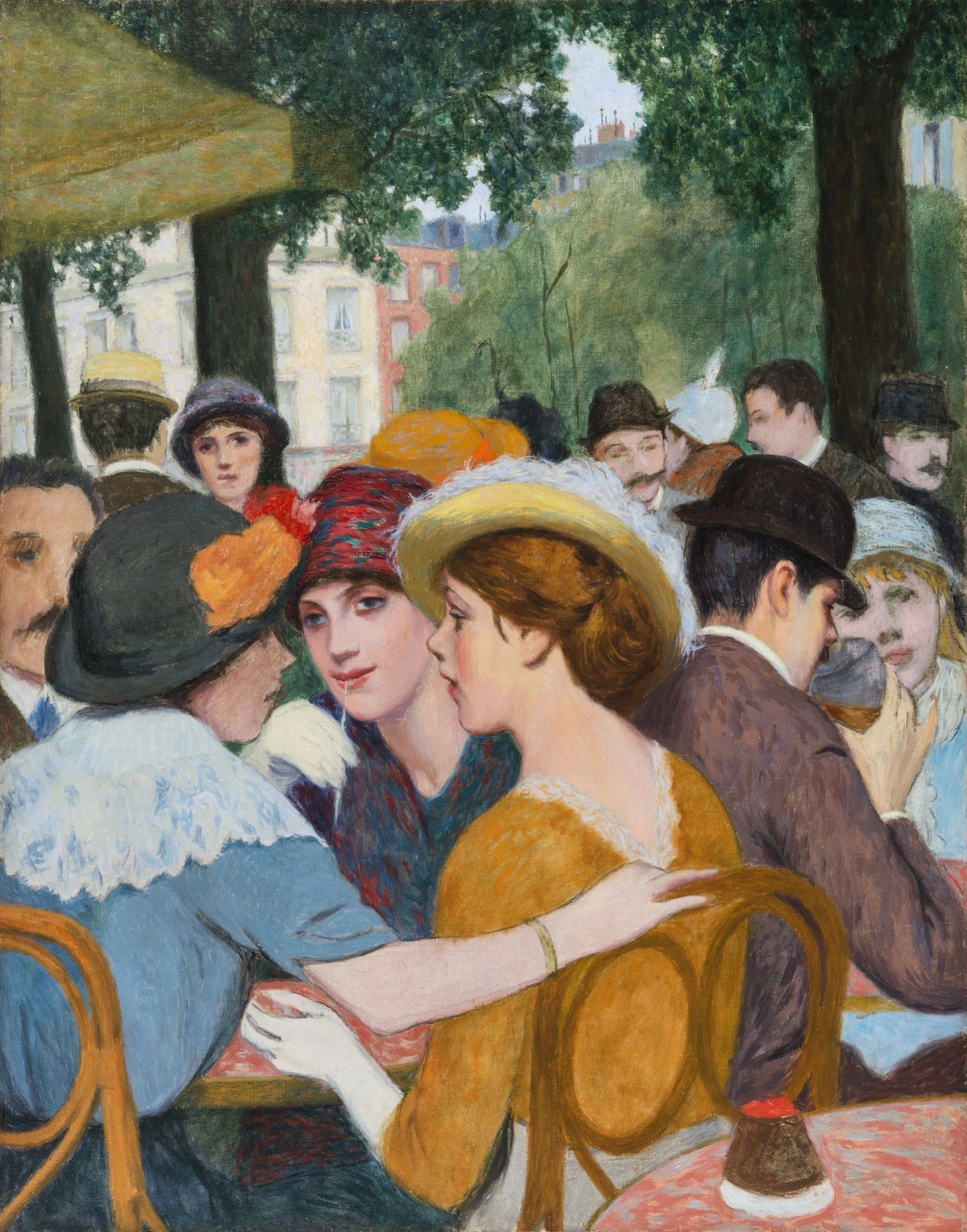
The exhibition closes with Federico Zandomeneghi (1842-1917) who, in 1874, definitively moved to Paris and launched nineteenth century Venetian painting to an international level. By the end of the century, public and critics repeatedly declared this school an enormous and irrefutable success.
A catalog by Bottegantica Editions accompanies the exhibition.
Milan, January 2017